




AMH is one of the most common blood tests done before IVF. And one of the first questions people ask after seeing their report is: “Is my AMH good enough to get pregnant?”
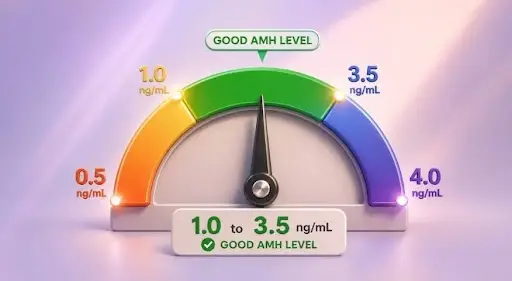
A single number on a report can feel like a verdict, especially when so much feels uncertain. But AMH is not a pass-or-fail score. In general, an AMH level between 1.0 and 3.5 ng/mL is considered a good range for IVF, though outcomes depend on age, overall health, and how the ovaries respond during treatment. Knowing what AMH actually tells you, and what it does not, can help you approach your fertility journey with more clarity and less anxiety.
Here is what you need to know.
Key takeaways
- AMH (Anti-Müllerian Hormone) reflects egg quantity, not egg quality.
- A good AMH level for IVF is generally between 1.0 and 3.5 ng/mL, though individual response varies.
- A low AMH value does not mean IVF cannot work. Many people conceive with lower levels when protocols are personalised.
- Age is a stronger predictor of IVF success than AMH alone.
- AMH can be tested on any day of the menstrual cycle.
- Very high AMH (above 3.5 to 4.0 ng/mL) may indicate a risk of ovarian hyperstimulation or PCOS.
What is AMH and why does it matter for IVF?
AMH stands for Anti-Mullerian Hormone. Small follicles in the ovaries produce this hormone, and its level in the blood gives an estimate of how many eggs are remaining. In medical terms, this is called ovarian reserve.
Before starting an IVF cycle, doctors use AMH alongside other markers like AFC (antral follicle count) and FSH (follicle-stimulating hormone) to understand how the ovaries may respond to stimulation medication. A higher AMH generally suggests more follicles are available, which may lead to more eggs during retrieval. A lower AMH suggests fewer follicles, which can mean fewer eggs retrieved in a single cycle.
AMH tells you about quantity, not quality
One of the most important things to understand is that AMH measures egg count, not egg quality. Two people with the same AMH level can have very different IVF outcomes depending on factors like age, genetics, and embryo development. According to the American Society for Reproductive Medicine (ASRM), AMH and AFC predict ovarian response to stimulation well, but they are not standalone fertility tests.
What is a good AMH level to get pregnant with IVF?
There is no single “perfect” AMH number. However, general clinical ranges give doctors an idea of what to expect during treatment.
- Very low <0.9 ng/mL: Often associated with a very low ovarian reserve. Fewer eggs may be retrieved, and cycle cancellation risk may be higher.
- Low 1.0 – 1.9 ng/mL: Considered low. Ovarian response to stimulation medication may be limited, and protocols may need careful adjustments.
- Normal 2.0 – 5.9 ng/mL: Generally viewed as a normal, healthy AMH value range for most people of reproductive age. Doctors often see a balanced response to IVF stimulation in this range.
- High 6.0 ng/mL: May indicate a high ovarian reserve. While more eggs may be retrieved, there is also a higher risk of ovarian hyperstimulation syndrome (OHSS) or an association with PCOS.
An AMH value for pregnancy through IVF is typically most reassuring between 1.0 and 3.5 ng/mL, but these are guidelines, not guarantees. Individual response can vary significantly.
How AMH levels change with age
AMH levels naturally decline as a person gets older. Peak levels are generally seen in the mid-20s, with a gradual drop through the 30s and a sharper decline after the late 30s.
Here is a general reference for AMH levels by age:
- Age 25 to 30: Approximately 2.5 to 5.0 ng/mL
- Age 31 to 35: Approximately 1.5 to 4.0 ng/mL
- Age 36 to 40: Approximately 1.0 to 3.0 ng/mL
- Age 41 to 45: Approximately 0.5 to 2.0 ng/mL
- Above 45: Often below 1.0 ng/mL
AMH ranges can vary by lab and individual. Values consistently above 4.0 ng/mL may sometimes warrant further evaluation for conditions like PCOS.
Why the same AMH number means different things at different ages
A 28-year-old with an AMH of 1.2 ng/mL and a 40-year-old with the same AMH of 1.2 ng/mL are in very different situations. The younger person is more likely to have better egg quality, which plays a major role in embryo development and implantation. A large cohort study found that younger people with low AMH still achieved better pregnancy and live birth rates through IVF compared to older people with higher AMH. Age remains the more critical factor in determining IVF outcomes.
Can you get pregnant with IVF if your AMH is low?
Yes. A low AMH level does not mean pregnancy through IVF is impossible.
The ASRM has clearly stated that extremely low AMH levels should not be used to refuse IVF treatment. While fewer eggs may be retrieved per cycle, the quality of those eggs, along with sperm health, embryo development, and uterine receptivity, all influence the outcome.
What matters alongside AMH
Several factors work together in determining whether IVF can lead to pregnancy:
- Age and egg quality: Egg quality tends to decline with age, independent of AMH levels. Younger eggs are more likely to develop into healthy embryos.
- Sperm health: DNA fragmentation, motility, and morphology all play a role in fertilisation and embryo quality. A male fertility assessment can identify issues that may not be obvious from a basic semen analysis.
- Uterine environment: Endometrial thickness, receptivity, and timing of embryo transfer affect implantation.
- Protocol design: Personalised stimulation protocols, tailored to how someone’s body responds, can make a meaningful difference in IVF outcomes.
A low AMH level for pregnancy may simply mean the approach needs to be adjusted, not abandoned.
Does a high AMH guarantee IVF success?
Not necessarily. Research published in PMC (PubMed Central) found that while higher AMH levels predicted a greater number of retrieved eggs and good quality embryos, high AMH was not an independent predictor of clinical pregnancy rates in IVF cycles.
The role of PCOS in high AMH
AMH levels above 4.0 to 5.0 ng/mL may sometimes be associated with polycystic ovary syndrome (PCOS). PCOS can cause irregular ovulation and may increase the risk of ovarian hyperstimulation during IVF. In such cases, doctors often adjust medication doses carefully to avoid complications while still supporting a healthy response.
How is AMH tested?
AMH testing is a simple blood test. Unlike FSH, which needs to be tested on specific days of the menstrual cycle, AMH can be drawn on any day. The levels generally remain relatively stable throughout the cycle, though minor fluctuations can occur. For most clinical purposes, any-day testing is considered reliable and convenient.
When to consider getting your AMH tested
AMH testing may be helpful if you are:
- Over 25 and planning to conceive in the near future
- Considering egg freezing and want to understand your ovarian reserve
- About to start IVF or another assisted reproductive treatment
- Experiencing irregular periods or have a family history of early menopause
A female fertility assessment typically includes AMH along with other hormonal and ultrasound markers to give a fuller picture.
What does “optimal fertility” actually mean?
Optimal fertility meaning varies from person to person. For one individual, it may mean having a high ovarian reserve and conceiving without assistance. For another, it may mean responding well to stimulation medication during IVF.
There is no universal definition because fertility depends on many interconnected factors: egg quality, sperm parameters, hormonal balance, uterine health, lifestyle, and emotional wellbeing. Rather than chasing a single number, a more meaningful approach is to look at the whole picture.
A personalised assessment matters more than a single test
AMH is one piece of a larger puzzle. Combining AMH results with AFC, hormonal profiling, and a detailed medical history gives a far more accurate picture of where someone stands. Two people with the same AMH can have very different fertility profiles, and treatment planning should reflect that.
Can you improve your AMH levels?
AMH levels are primarily determined by the number of follicles in the ovaries, and this number naturally decreases over time. No treatment or supplement has been shown to significantly increase AMH.
However, supporting overall ovarian health may contribute to better quality eggs. A few things that may help:
- Balanced nutrition: A diet rich in antioxidants, healthy fats, and adequate protein may support cellular health.
- Stress management: Chronic stress can affect hormonal balance and overall well-being.
- Adequate sleep: Consistent, quality sleep supports hormone regulation.
- Avoiding smoking: Smoking is associated with faster decline in ovarian reserve.
- Supplements (with medical guidance): Some clinicians suggest CoQ10 or Vitamin D, though these should always be discussed with a fertility specialist first.
The focus should not be on raising AMH itself but on creating the best conditions for egg health and response to treatment. For those who want to begin preparing their body before treatment, a structured pre-conception journey can help address nutrition, lifestyle, and hormonal balance early on.
Understanding your AMH in the context of your journey
At Luma fertility, we believe that a number on a report should never define your entire fertility journey. AMH is an important marker, but fertility is shaped by many factors working together, and each person’s path looks different.
Our fertility assessments go beyond a single hormone test. We combine AMH with AFC, hormonal profiling, and detailed medical history to create a picture that is specific to you. For those considering IVF, egg freezing, or simply wanting to understand where they stand, our approach is built around personalised care, not assumptions.
If you would like to understand what your AMH level means for your individual situation, speak with our fertility care specialist today.
Note – This blog is for educational purposes only and should not be used as a basis for self-medication or treatment decisions. Always consult a qualified medical professional before starting or changing any treatment.
Faqs
Q. What is a good AMH level for IVF?
An AMH level between 1.0 and 3.5 ng/mL is generally considered a good range for IVF. People in this range tend to respond well to stimulation medication and produce a reasonable number of eggs for retrieval. However, outcomes depend on age, egg quality, and other individual factors alongside AMH.
Q. Can IVF work with a very low AMH?
Yes, IVF can still lead to pregnancy even with very low AMH levels. The ASRM has stated that extremely low AMH should not be used to deny IVF treatment. Fewer eggs may be retrieved, but with the right protocol and expert embryology support, successful outcomes are still possible.
Q. Does AMH predict egg quality?
No. AMH reflects the number of eggs remaining in the ovaries, not the quality of those eggs. Egg quality is influenced more by age, genetics, and overall health. Someone with a lower AMH but younger age may still have eggs of good quality.
Q. How often should AMH be tested?
For most people, testing once a year is sufficient, especially if you are over 30 and planning to conceive. If you are about to start IVF or egg freezing, your doctor may recheck AMH closer to the treatment cycle. AMH can be drawn on any day of the menstrual cycle.
Q. Is a very high AMH level a concern?
AMH levels above 3.5 to 4.0 ng/mL may sometimes be linked with PCOS or a higher risk of ovarian hyperstimulation syndrome (OHSS) during IVF. While a high ovarian reserve generally sounds positive, the stimulation protocol may need careful adjustment to avoid complications.
Q. What is the difference between AMH and AFC?
AMH is a blood test that estimates egg quantity based on hormone levels. AFC (antral follicle count) is an ultrasound-based measurement that counts the visible small follicles in the ovaries. Both provide information about ovarian reserve, and doctors often use them together for a more complete assessment.
Sources referenced:
- American Society for Reproductive Medicine (ASRM) – Testing and interpreting measures of ovarian reserve: a committee opinion (2020)
- Cleveland Clinic – Anti-Mullerian Hormone (AMH) Test: Purpose, Levels & Results
- PubMed Central (PMC) – High anti-Mullerian hormone levels might not reflect the likelihood of clinical pregnancy rate in IVF/ICSI treatment