




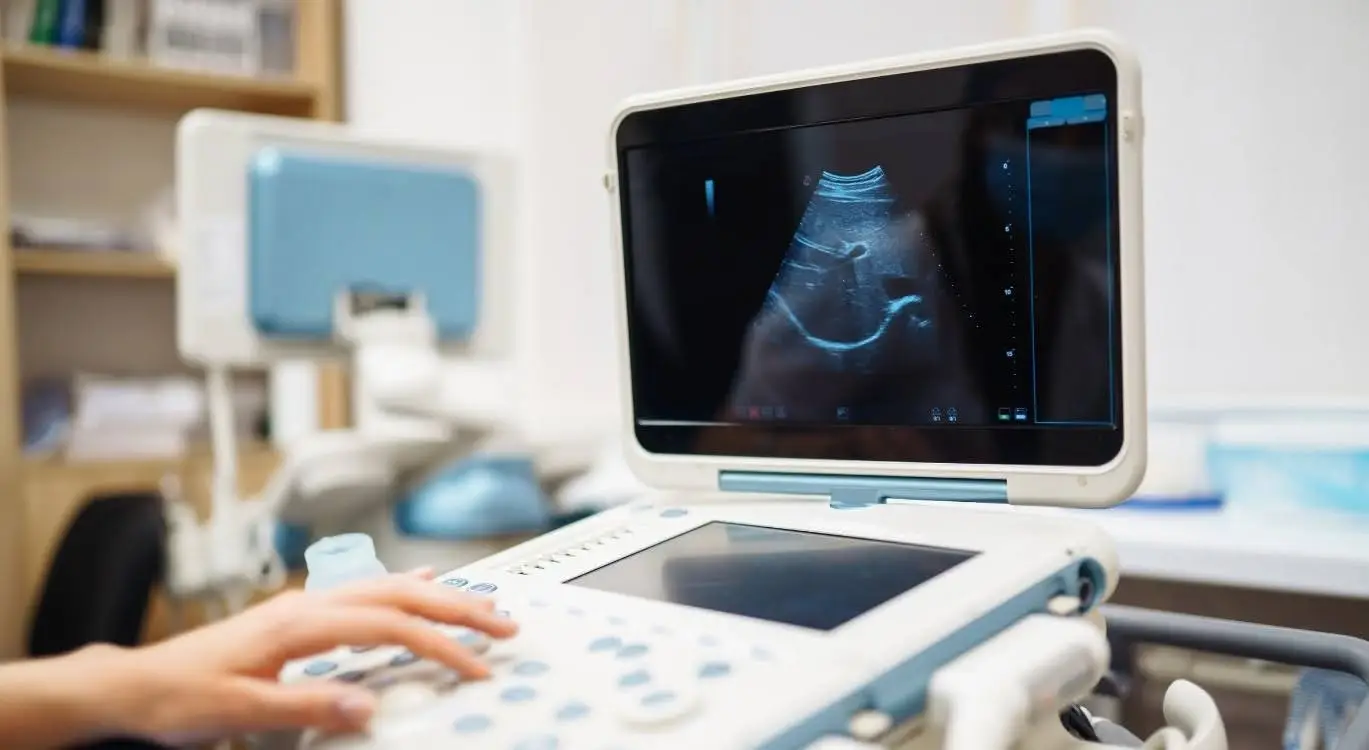
If you have ever visited a doctor for abdominal pain, irregular periods, or a routine pregnancy check-up, chances are you have been advised a “USG.” The USG full form is ultrasonography, a safe imaging method that uses sound waves instead of radiation. The term appears frequently on prescriptions and diagnostic referrals, but many people are unsure what it actually means or why it is recommended. Here is a clear, simple breakdown of what USG is, how it works, and when it is used.
Key takeaways
- The USG full form is ultrasonography, also called ultrasound sonography.
- A USG scan uses high-frequency sound waves to create images of organs inside the body.
- Unlike X-rays or CT scans, USG does not use radiation, making it one of the safest imaging methods available.
- USG full form in pregnancy refers to the same tool, used specifically to monitor the developing foetus and placenta.
- Common types include abdominal USG, pelvic USG, transvaginal USG, and obstetric (pregnancy) USG.
- USG also plays a role in fertility assessments, where it helps evaluate ovarian reserve through antral follicle count.
What is USG?
USG stands for ultrasonography, a diagnostic imaging method that uses high-frequency sound waves to produce real-time images of structures inside the body. Most people know it simply as an “ultrasound.”
How does USG work?
A small handheld device called a transducer is placed on the skin (or, in some cases, inserted gently into the body). The transducer sends sound waves into the body. When these waves hit an organ, tissue, or fluid, they bounce back. A computer then converts these returning echoes into images displayed on a screen.
No needles, no cuts, and no radiation are involved. The entire process is painless in most cases and usually takes between 15 and 45 minutes, depending on the type of scan.
Why is USG considered safe?
Unlike X-rays and CT scans, USG does not expose the body to ionising radiation. According to the World Health Organisation and multiple clinical bodies globally, diagnostic ultrasound is considered safe when used appropriately, including during pregnancy. The procedure has been in clinical use for decades, and current evidence has not identified harmful effects when used at standard diagnostic levels.
What is USG used for?
Doctors recommend USG across a wide range of situations. Some of the most common reasons include:
- Examining organs in the abdomen, such as the liver, kidneys, gallbladder, spleen, and pancreas
- Evaluating pelvic organs, including the uterus, ovaries, and bladder
- Monitoring foetal development during pregnancy
- Checking for kidney stones, gallstones, or cysts
- Assessing blood flow through arteries and veins (Doppler USG)
- Guiding certain medical procedures, such as biopsies
- Supporting fertility evaluations, including antral follicle count for ovarian reserve assessment
USG is often the first imaging test a doctor will order because it is quick, affordable, widely available, and does not require any recovery time.
Common types of USG scans
While the basic principle remains the same across all types, the scan is adapted depending on which part of the body needs to be examined. Your doctor will recommend the specific type based on your symptoms or clinical needs.
Abdominal USG
An abdominal USG examines the organs inside the abdomen, including the liver, gallbladder, pancreas, spleen, kidneys, and bladder. Doctors commonly advise this scan for unexplained abdominal pain, bloating, or digestive complaints. Fasting for 6 to 12 hours before the scan may be required, depending on the diagnostic centre’s protocol, especially when the gallbladder needs to be evaluated clearly.
Pelvic USG
A pelvic USG focuses on the reproductive organs and bladder. For women, the scan can assess the uterus and ovaries. Doctors may recommend a pelvic USG for irregular periods, pelvic pain, suspected fibroids, ovarian cysts, or as part of a fertility assessment. A full bladder is usually required before the scan to improve image clarity.
Transvaginal USG (TVS)
A transvaginal USG provides a closer and more detailed view of the uterus, ovaries, and cervix. A slim, lubricated probe is gently inserted into the vagina. Doctors may advise a TVS when pelvic findings need more detail, during early pregnancy, or for evaluating conditions such as PCOS, endometriosis, or unexplained pelvic pain. In the context of fertility care, TVS is commonly used to perform an antral follicle count (AFC), which helps estimate ovarian reserve and may guide treatment planning for IVF or egg freezing. For those exploring back-to-back egg retrievals, USG helps assess ovarian recovery and readiness between cycles.
Obstetric (pregnancy) USG
The USG full form in pregnancy is the same, ultrasonography, but the focus shifts entirely to monitoring the developing foetus. Pregnancy USG confirms the pregnancy, checks the foetal heartbeat, estimates gestational age, and tracks growth over time. Key scans during pregnancy typically include:
- Dating scan (6 to 9 weeks): Confirms the pregnancy and estimates the due date.
- NT scan or nuchal translucency scan (11 to 14 weeks): Screens for the chance of certain chromosomal conditions.
- Anomaly scan (18 to 22 weeks): A detailed scan that checks the development of the brain, heart, spine, kidneys, and other organs.
- Growth scan (third trimester): Monitors foetal growth, placental position, and amniotic fluid levels.
Early pregnancy scans may require a full bladder. Later scans usually need no special preparation.
Other types of USG
- Doppler USG: Studies blood flow in arteries and veins. Often used to check circulation in pregnancy or to evaluate vascular conditions.
- Echocardiogram: A specialised USG of the heart that assesses its structure, movement, and function.
- Breast USG: Used to examine lumps or abnormalities in breast tissue.
- Thyroid USG: Evaluates the thyroid gland for nodules, enlargement, or other changes.
- Musculoskeletal USG: Examines joints, muscles, tendons, and soft tissues for injuries or inflammation.
How to prepare for a USG scan
Preparation depends on the type of scan. Your doctor or diagnostic centre will give you specific instructions. As a general guide:
- Abdominal USG: Fasting for 6 to 12 hours may be needed, particularly if the gallbladder or liver is being assessed.
- Pelvic USG: Drinking water and holding your bladder before the appointment can improve image quality.
- Transvaginal USG: Usually, no special preparation is needed.
- Pregnancy USG: Early scans may require a full bladder, while later scans typically need no preparation.
Wearing loose, comfortable clothing can make the process easier.
How to read a USG report
A USG report describes the organs examined and notes whether anything unusual was observed. Here are some simple pointers:
- Normal results will usually state that findings are “within normal limits” or “unremarkable.”
- Abnormal results may mention terms like “mass,” “cyst,” “calculus” (stone), or “fluid collection.” Any such finding should be reviewed by your doctor, as not all abnormalities indicate a serious concern.
- Pregnancy reports include measurements such as foetal heart rate, gestational age, foetal size, and placental position. Your doctor will explain what these numbers mean for your specific situation.
Always discuss USG findings with your doctor rather than interpreting the report on your own.
USG in fertility assessments
Ultrasound plays an important role in evaluating reproductive health. For individuals exploring their fertility, a transvaginal USG may be used to count antral follicles on the ovaries. Antral follicle count (AFC) is one of the key markers used to estimate ovarian reserve, alongside blood tests such as AMH (anti-Müllerian hormone).
AFC, combined with hormone levels, helps specialists understand how the ovaries may respond to treatment and supports informed planning for options like IVF or egg freezing. USG is also used during IVF cycles to monitor follicle growth during stimulation and to guide the timing of egg retrieval. During the stimulation phase, regular injections are administered while USG scans track how the follicles are responding at each stage.
For men, ultrasound may occasionally be part of a male fertility assessment to evaluate the reproductive organs when needed.
Understanding your options with personalised guidance
Whether you are exploring USG as part of a routine health check, a pregnancy milestone, or a fertility evaluation, the scan itself is just one piece of the picture. What matters most is how the results are interpreted in the context of your individual health and goals.
At Luma fertility, every fertility assessment is designed around the individual, not around averages. From personalised evaluations to evidence-based guidance for IVF, egg freezing, or a pre-conception journey, we focus on clarity, not guesswork.
If you are looking for personalised fertility guidance based on your own health profile, book a consultation to take the first step with support and evidence.
Note: This blog is for educational and informational purposes only and is not a substitute for professional medical advice. Always consult a qualified healthcare provider for diagnosis and treatment decisions.
FAQs
Q: What is the USG full form in medical terms?
The USG full form is ultrasonography, also referred to as ultrasound sonography. Doctors use the abbreviation USG when advising imaging tests for the abdomen, pelvis, pregnancy, and other areas of the body.
Q: Is USG safe during pregnancy?
Diagnostic ultrasound has been used during pregnancy for decades and is considered safe by leading global health bodies. USG does not use radiation, and current evidence has not identified risks to foetal health when used at standard diagnostic levels.
Q: How many USG scans are typically done during pregnancy?
In a low-risk pregnancy, doctors usually recommend three to four key scans: a dating scan around 6 to 9 weeks, an NT scan at 11 to 14 weeks, an anomaly scan at 18 to 22 weeks, and a growth scan in the third trimester if needed. Additional scans may be advised based on individual circumstances.
Q: Do I need to fast before a USG scan?
Fasting may be required for an abdominal USG, especially when the gallbladder or liver is being examined. The required duration can range from 6 to 12 hours depending on the centre. Pelvic and pregnancy USG scans generally do not require fasting. Your doctor or diagnostic centre will provide specific instructions.
Q: Can USG detect fertility-related conditions?
A transvaginal USG can help evaluate conditions such as PCOS, fibroids, ovarian cysts, and endometriosis. Antral follicle count performed via USG is also a key part of ovarian reserve assessment, which supports fertility planning and treatment decisions.
Q: What is the difference between USG and sonography?
There is no difference. Sonography and ultrasonography (USG) refer to the same imaging technique. Both terms describe the use of sound waves to produce images of internal body structures.
Sources:
- WHO – Manual of diagnostic ultrasound
- WHO systematic review – Safety of ultrasonography in pregnancy (PubMed)
- Cleveland Clinic – Pelvic Ultrasound
- Cleveland Clinic – Transvaginal Ultrasound
- Cleveland Clinic – Ovarian Reserve Testing
- NCBI StatPearls – Pelvic Ultrasound
- NCBI StatPearls – Female Pelvic Sonography
- ASRM – Ovarian Reserve
- NCBI – Ovarian Reserve Testing